


Dragon Tiger is a high-speed game and that speed often leads players to make rushed decisions without a clear strategy. Instead of relying on instinct, seasoned players pay close attention to table behavior and short-term patterns before placing their bets. These dragon tiger strategy tips are designed to explain those practical methods in a clear and structured way, making them easier to apply during live sessions on Jili777.
Dragon tiger game rules – The foundation of all dragon tiger strategy tips
Dragon Tiger is a fast-paced live casino game built around simplicity and speed. In each round, the player’s objective is to predict whether Dragon or Tiger will receive the higher-value card. In addition to the main bets, players may also wager on Tie or Suited Tie, depending on their risk preference.
The game is played using eight standard decks of cards (8 decks), with Jokers removed. At the start of every round, the dealer deals one face-up card to Dragon and one face-up card to Tiger. Card values are ranked from lowest to highest as follows: Ace (A) – 2 – 3 – 4 – 5 – 6 – 7 – 8 – 9 – 10 – Jack (J) – Queen (Q) – King (K), where Ace is the lowest and King is the highest.
If Dragon’s card has a higher value, the Dragon bet wins. If Tiger’s card is higher, the Tiger bet wins. If both cards have the same value, the result is declared a Tie. Understanding this core mechanic is essential before applying any dragon tiger strategy tips, as each betting option carries a different level of risk and expected return.
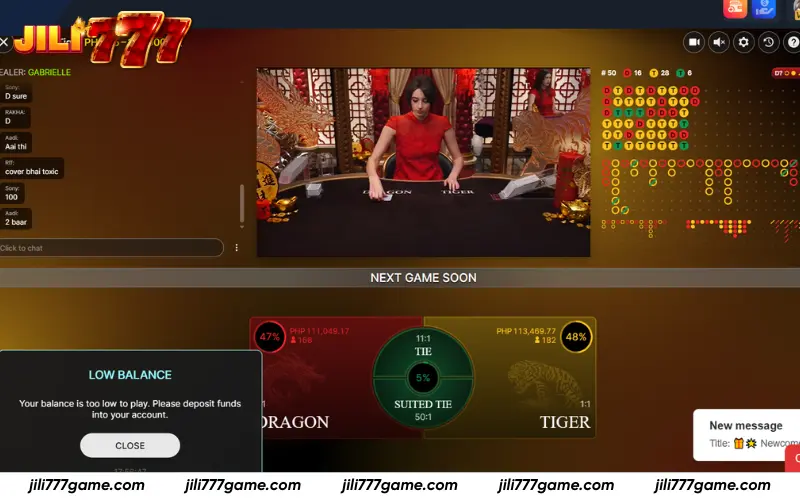
Dragon tiger payout table
Below is the standard payout structure used in Dragon Tiger:
| Bet Type | Payout |
| Dragon | 1 : 1 |
| Tiger | 1 : 1 |
| Tie | 11 : 1 |
| Suited Tie | 50 : 1 |
Important note: If the outcome is Tie or Suited Tie, half of the original Dragon or Tiger bet is returned to the player. While this reduces part of the loss on main bets, it does not eliminate the house edge, which is a key point often highlighted in advanced dragon tiger strategy tips.
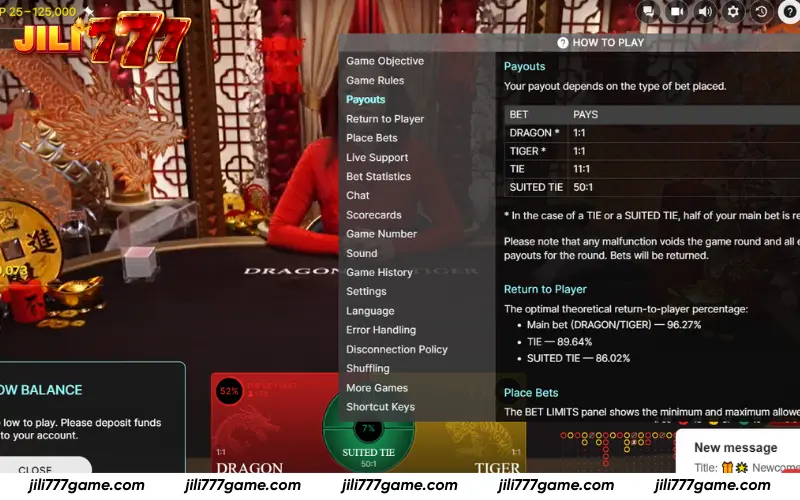
Return to player (RTP) – Key data behind dragon tiger strategy tips
According to the official game information, the theoretical Return to Player (RTP) values are:
- Dragon / Tiger: approximately 96.27%
- Tie: approximately 89.64%
- Suited Tie: approximately 86.02%
These figures explain why most professional dragon tiger strategy tips focus on Dragon and Tiger bets. Despite the attractive payouts of Tie and Suited Tie, their lower RTP and higher house edge make them unsuitable for long-term play.
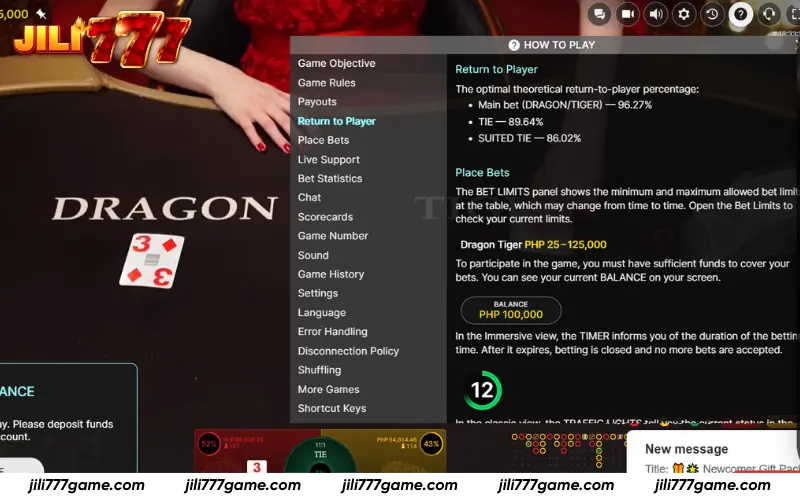
Dragon tiger strategy tips: Practical pattern reading methods used by experienced players
In Dragon Tiger, experienced players rarely rely on luck alone. Most decisions are shaped by short-term pattern reading and disciplined betting control.
Flat Streaks (Dragon Streak / Tiger Streak)
A flat streak occurs when the same side-Dragon or Tiger-appears consecutively for 2 to 5 rounds. From a statistical perspective, this is completely normal. Each side has an approximate 44.6% win probability, so short streaks are a natural result of random distribution in a fast-paced game like Dragon Tiger. The mistake many players make is assuming a streak represents a “strong pattern,” when in reality it is simply short-term variance.
The correct way to approach flat streaks is to follow only short streaks (2-4 rounds) using small, consistent bets. Stake size should never increase during a streak, as one reversal is enough to erase previous gains. Experienced players treat flat streaks as quick entry-exit opportunities, not as a long-term betting foundation.
When a streak extends too long (5-6 rounds or more), risk increases sharply due to emotional chasing. Sudden reversals after extended streaks are common signs of table instability.

Alternating Patterns (1-1 and 2-2)
The 1-1 alternating pattern follows a simple rhythm such as Dragon – Tiger – Dragon – Tiger. This is one of the easiest patterns to recognize and often appears during periods when the table flow feels balanced. While every round remains independent, this short alternation frequently repeats over brief windows due to natural variance.
The 2-2 pattern-Dragon – Dragon – Tiger – Tiger-offers a slightly slower rhythm, which helps players maintain emotional control. However, this pattern should only be followed after it repeats for at least two full cycles. Acting on a single appearance often turns disciplined play into guesswork.
One core rule applies to both patterns: a single break means stop immediately. Waiting for the pattern to “return” is a common trap, as dragon tiger has no memory.
2-1 and 3-1 Rhythm Patterns
The 2-1 and 3-1 patterns are among the most practical structures seen in real play. Examples include Dragon – Dragon – Tiger or Dragon – Dragon – Dragon – Tiger. These patterns align well with short-term probability swings and appear frequently without creating overly long, misleading streaks.
Their main advantage lies in clarity. The structure is easy to identify and does not require complex interpretation. When a pattern repeats at least twice, players may enter on the final step of the sequence using controlled stakes. Crucially, this approach focuses on timing, not prediction.
A common error is extending expectations beyond the pattern itself-turning 3-1 into imagined 4-1 or 5-1 sequences. These rhythm patterns are effective only when applied strictly; discipline matters more than pattern length.

Broken Patterns
A broken pattern occurs when results become erratic, showing no repeatable structure. Outcomes flip unpredictably, often with Tie results interrupting any emerging rhythm. This is not bad luck-it is a natural phase of random distribution where pattern reading offers no advantage.
Behavioral data shows that during broken patterns, players tend to “invent” logic where none exists. This leads to poor entries, emotional betting and rapid bankroll decline-especially when combined with chasing behavior.
The correct response is simple: do not force a pattern. Step away, switch tables, or end the session.
Tie Results – Observe frequency, never chase
Tie results occur in only 8-9% of total rounds, making them statistically rare. Real table data confirms that Tie outcomes do not form stable streaks or reliable rhythms. Their appearance is random and unsuitable for pattern-based strategies.
The biggest mistake is treating Tie as part of the main pattern or using it as a recovery tool after losses on Dragon or Tiger. High payouts encourage oversized bets, while the house edge on Tie remains extremely unfavorable.
The correct approach is to observe Tie frequency only as a table indicator, never as a primary betting signal. If used at all, it should be minimal and infrequent. Tie is an observational element, not a pattern worth following.
5 dragon tiger strategy tips: Understand the rules, play with the right strategy
Dragon Tiger is often seen as a fast and simple casino game, but simplicity does not mean low risk. In fact, without proper control, the house edge can erode a bankroll surprisingly quickly. The following dragon tiger strategy tips are not based on intuition or superstition, but on RTP figures, probability calculations and real betting behavior observed at live tables.
Focus Only on Dragon or Tiger – The Highest RTP Bets
According to standard Dragon Tiger payout structures:
- Dragon / Tiger: average RTP ~ 96.27%
- Tie: RTP ~ 89.64%
- Suited Tie: RTP ~ 86.02%
This translates into the following house edge levels:
- Dragon/Tiger: approximately 3.7%
- Tie: over 10%
- Suited Tie: nearly 14%
From a probability standpoint, when one card is drawn for each side from a 52-card deck:
- Probability of Dragon winning ≈ 44.6%
- Probability of Tiger winning ≈ 44.6%
- Probability of a Tie ≈ 8.5%
In practical terms, a Tie occurs roughly 8-9 times per 100 rounds, yet many players overbet this option due to its high payout. Over time, this mismatch between probability and payout accelerates losses.

Tie Bets Are Not “Big Win Opportunities” – They Drain Capital Faster
Tie payouts such as 11:1 or 50:1 are designed to exploit the desire for quick, large returns. However, the actual probability of a Tie does not justify these payouts from a player’s perspective.
For example:
- A payout of 11:1 would require a breakeven probability close to 9.1%
- The real probability remains around 8.5%
- The gap represents a consistently unfavorable house edge
Observed table behavior shows that players who bet Tie frequently tend to:
- Increase stakes irrationally after consecutive misses
- Abandon their original strategy
- Lose bankroll faster despite occasional wins
Flat Betting Is the Only Reliable Way to Control Risk
Dragon Tiger typically runs at 20-30 rounds in 10 minutes, making it faster than Baccarat. In such conditions, progressive systems like Martingale become extremely dangerous.
Example:
- Bankroll: 100 units
- Starting bet: 2 units
- Six consecutive losses require a recovery bet of 128 units → bankroll collapse
Flat betting limits exposure by:
- Keeping risk per round at 1-3% of bankroll
- Preventing emotional overbetting
- Allowing accurate evaluation of performance without stake distortion

Observe Short Streaks for Timing – Never for Prediction
Mathematically:
- Each Dragon Tiger round is an independent event
- Previous results have zero influence on future outcomes
In practice:
- Short streaks of 3-5 identical results are common
- Long streaks of 8-10 can occur, but are rare
The danger lies in psychology. Long histories create false pattern recognition, leading players to:
- Bet against streaks too aggressively
- Increase stakes at the worst possible moment
- Break discipline
Limit the Number of Rounds Per Session to Reduce House Edge Impact
House edge does not harm players in a single round-it accumulates across volume. The more rounds played, the clearer the negative expectation becomes.
Example:
- Dragon/Tiger house edge ≈ 3.7%
- Over 100 flat-bet rounds, expected loss ≈ 3.7 units per 100 units wagered
Because Dragon Tiger is fast:
- 100 rounds can be completed in under 40 minutes
- Losses often go unnoticed until the session ends
Practical limits:
- 20-30 rounds per session, or
- 10-15 minutes per session, followed by a break
Experience from long-time dragon tiger players
Over many sessions, experienced players have learned that success in Dragon Tiger comes from observation, not prediction—a principle clearly reflected in dragon tiger strategy tips.
|
Name |
Country |
Shared Experience |
|
Alex Wong |
Singapore |
I stick to flat bets and avoid chasing Tie payouts |
|
Marco Silva |
Brazil |
Dragon Tiger works best when I limit session time |
|
Nguyen Minh Quan |
Vietnam |
Main bets are enough; Tie is just a trap if overused |
| Lars Becker | Germany |
Stopping after small profits keeps variance under control |

Conclusion
Effective Dragon Tiger play is not about predicting outcomes, but about applying discipline, timing, and controlled decision-making over time. By following the dragon tiger strategy tips outlined above, players can reduce unnecessary risk and approach each session with a clearer structure. If you want to observe real table patterns and apply these strategies in a stable live environment, visit Jili777 and start practicing smarter, more controlled Dragon Tiger gameplay today.
JILI777 is an online gaming platform offering a variety of Slot game, casino games and sports betting, known for its secure environment and attractive bonuses.